Why does the perfect temperature keep changing?

The thermostat measures air. You feel air, humidity, sun, motion, clothing and your own body heat, all at once. Flip a few of them on and watch your just-right number move.

70°−2° from 72°
Start at 72°F on a mild day. Then add (example numbers)
  • −2°Sunlight adds heat the thermostat never measures.

Why does the same temperature feel different?

Seven scenes, one number. Scroll, or use the arrows, and watch your just-right temperature move.

72°on the thermostat

72°F can feel chilly in January and stuffy in July.

Air temperature is one of six things that set comfort. The others: humidity, heat radiating from the surfaces around you, moving air, how active you are and what you wear.

Source: ASHRAE Standard 55

1 of 7 · example numbers
  1. 72°F can feel chilly in January and stuffy in July.

    Air temperature is one of six things that set comfort. The others: humidity, heat radiating from the surfaces around you, moving air, how active you are and what you wear.

    Source: ASHRAE Standard 55

  2. Humid air slows your sweat, so heat feels hotter.

    Sweat cools you only as it evaporates. At 100°F and 55% humidity, the National Weather Service heat index reads 124°F. On muggy days, your just-right number drops.

    Source: National Weather Service heat index

  3. Sunlight adds heat a shaded thermometer never sees.

    Direct sun can raise the heat index by up to 15°F. In a study of cars parked in the sun on hot days, cabin air averaged about 118°F after an hour, and dashboards reached about 156°F.

    Source: NWS; Vanos et al., Temperature 2018

  4. After a workout, your body keeps making heat.

    Your core can stay warm for a while after you stop, so a cooler room or car feels right for the next half hour or so. Body size, age and sex shift your number too: office comfort standards were built around an average man's metabolism.

    Source: Kenny & McGinn 2017; Kingma & van Marken Lichtenbelt 2015

  5. Your body cools itself down to fall asleep.

    Core temperature follows a daily rhythm. It dips in the evening as sleep approaches and bottoms out a couple of hours before you wake. A cooler bedroom helps that dip along.

    Source: Kräuchi 2007, Sleep Medicine Reviews

  6. Stress can leave your hands cold in a warm room.

    In a lab stress test, skin temperature fell at the fingers and hands while core temperature barely moved. That's one reason the same room feels colder on a hard day.

    Source: Vinkers et al., Stress 2013

  7. Your perfect number moves all day. Let it follow you.
Comfort is more than a nice-to-have.

Three reasons it matters, each with a study behind it.

60 to 67°F

the bedroom range most sleep guidance lands on

A cooler bedroom helps you fall asleep.

Your core temperature drops as sleep approaches, and your skin sheds that heat through your hands and feet. A room that's too warm, or humid, gets in the way. Most guidance lands near 60 to 67°F (16 to 19°C), and older adults often sleep better a little warmer.

Source: Kräuchi 2007; Okamoto-Mizuno 2012

Best temperature for sleep →

9%

less work done at 86°F than at the best temperature

Your brain works better when you stop noticing the room.

In a review of office studies, performance rose up to about 72°F (22°C) and fell above 74°F (23 to 24°C). At 86°F (30°C) people worked about 9% below their best.

Source: Seppänen, Fisk & Lei 2006, Lawrence Berkeley National Laboratory

Best thermostat settings →

+40°F

roughly how far a parked car in the sun can climb above outside air

Heat makes your heart work harder.

To cool you, your heart pumps more blood to the skin. That's fine for most people and real strain for some, especially older adults, people with heart disease and anyone on diuretics or beta blockers. A parked car in the sun heats far past the outside air within half an hour.

Source: Crandall 2010; CDC; McLaren 2005

Heat stress symptoms →

Or let your phone keep up with all of it.

Just Right is the iPhone app behind this site. It reads the weather, the sun, the hour and your recent workout, then sets your car and your home to what will feel right, in one tap.

Free

One tap for your Tesla
Just Right picks the cabin temperature and sends it through a Shortcut you set up once in the Tesla app. Start it from the app, the home screen widget or a Live Activity.
Your thermostat too
Set an Apple Home thermostat (ecobee, Honeywell, Mysa, Sensi, newer Nest) in the same tap, or use your own Shortcut. Home follows car can ready the house when you head back, and tells you each time, with Undo.
A quiet fan on sunny days
When the car has baked in the sun, it holds a touch warmer for the first minutes so the fan doesn't roar.
Places
Home, work, the gym: each gets its own starting point.
Shows its work
Every number comes with its reasons: starting point, weather, time of day, workout.

Plus subscription

Learns you
Tap Too warm or Too cool. It remembers the place, the weather and the hour, and nudges similar trips.
Cooler after a workout
Connect Apple Health and the car runs a little cooler after exercise, easing back over about 45 minutes. Health data stays on your iPhone.
Apple Intelligence
The on-device model weighs sun, humidity and the hour. Nothing leaves your iPhone.

Just Right is not affiliated with Tesla, Inc. Tesla is a trademark of Tesla, Inc. Just Right sets a comfortable temperature. It does not diagnose, treat or monitor any condition.

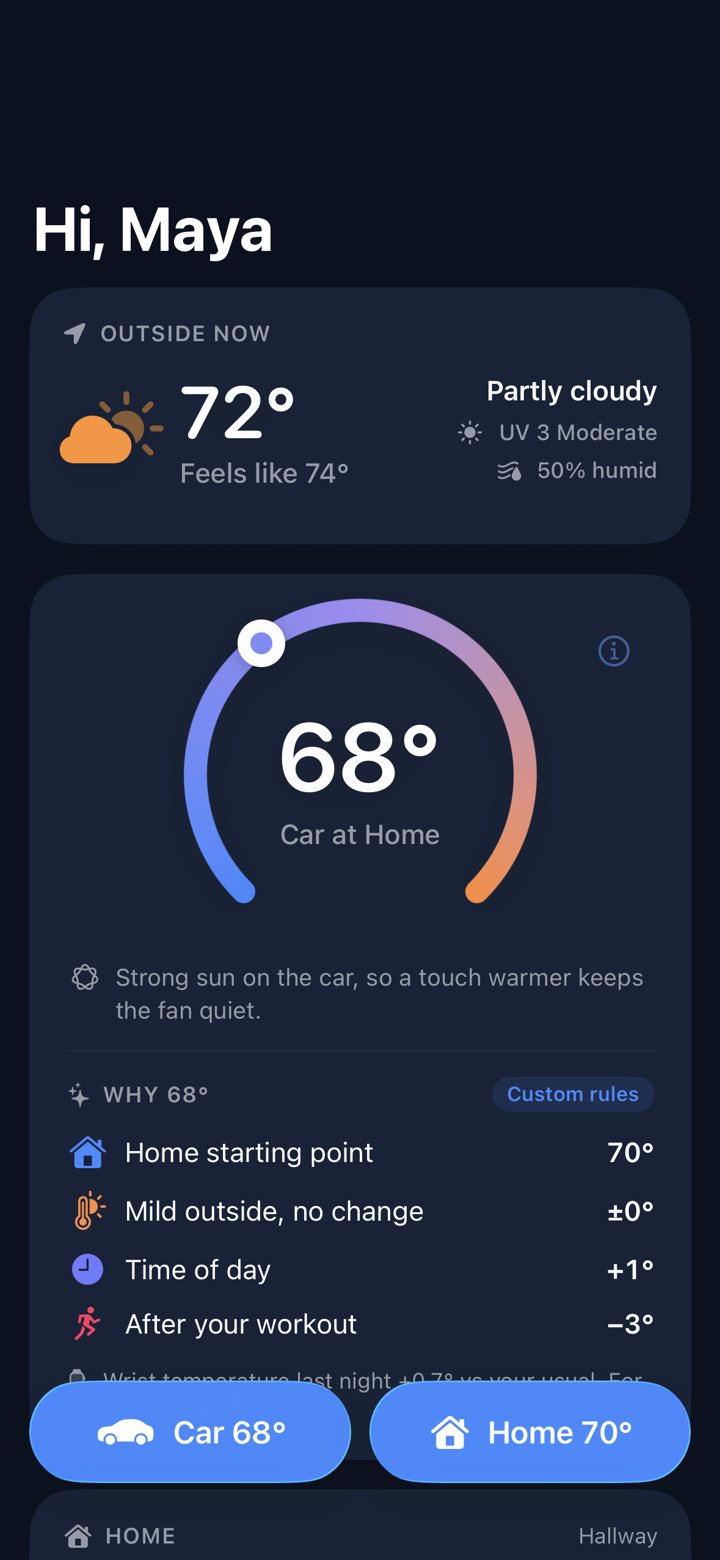
Just Right's Today screen: 72°F outside, feels like 74°F. Suggested 68°F for the car, with the reasons: home starting point 70°F, mild outside, time of day plus 1°F, after your workout minus 3°F.

Quick answers

What is the ideal room temperature?

No single number fits everyone. Comfort depends on six things: air temperature, humidity, heat from surrounding surfaces, air movement, activity and clothing (ASHRAE Standard 55). For energy use, the US Department of Energy suggests about 68 to 70°F (20 to 21°C) in winter while you're awake and as high as is comfortable in summer, with 78°F (26°C) a common target.

Recommended thermostat settings →

Why does 72 degrees feel cold in winter but fine in summer?

In winter, cold walls and windows pull heat from your skin even when the air reads 72°F, and dry indoor air makes skin feel cooler. In summer the same surfaces are warm and you wear lighter clothes, so the air temperature tells only part of the story.

Why 72°F can feel cold →

What does the feels like temperature mean?

It estimates how the air will affect your body once humidity or wind gets factored in. Weather services use the heat index on hot, humid days and wind chill on cold, windy days. It's measured in the shade, so direct sun can make it feel up to 15°F hotter.

Feels like temperature, explained →

What is the best temperature for sleep?

For most adults, a bedroom around 60 to 67°F (15.6 to 19.4°C) works well, with about 65°F (18°C) a common middle point. Older adults may sleep better a bit warmer, and babies need their own safe sleep rules.

Best temperature for sleep →

Why do I feel cold after a workout?

Sweat keeps evaporating after you stop, and your skin stays flushed with blood for a while, so you can lose heat fast in a cool room or a car with the AC on. Your core can still be warm while your skin feels chilled.

Why am I always cold? →

What temperature should I set my car to?

Start near what feels right at home, then go a couple of degrees cooler after the car has sat in the sun or after a workout, and a little warmer on cold mornings. A parked car in the sun heats far above the outside air, so cool it down before you get in when you can.

Tesla climate settings, explained →

Does the Just Right app work with my Tesla and thermostat?

Yes, on iPhone. It sends the temperature to your Tesla through a Shortcut you set up once in the Tesla app, and it can set a thermostat in Apple Home, such as ecobee, Honeywell, Mysa, Sensi or a newer Nest. It's coming soon to the App Store and isn't affiliated with Tesla.

See the app →

Get in. It’s already just right.

Just Right for iPhone sets your Tesla and your thermostat for the weather, the hour and you.